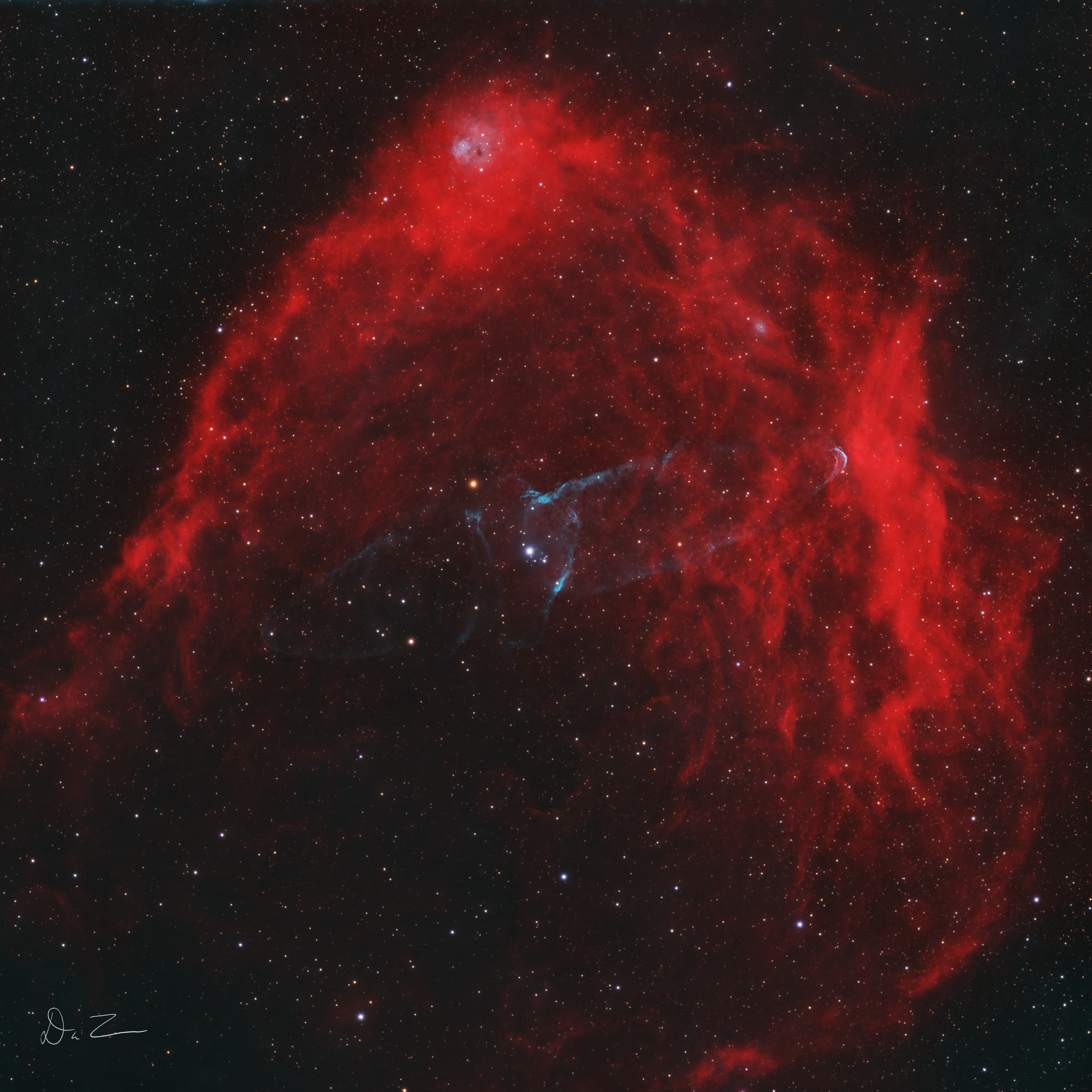
The Flying Bat and the Squid
Some 2,300, light-years away is Sh2-129, which is known by it’s more common name: the Flying Bat Nebula. It is a large emission nebula located in the constellation Cepheus comprised primarily of ionized hydrogen gas. Within the heart of the Flying Bat, you’ll also find Ou4, the Squid Nebula, which is an extraordinarily faint bipolar planetary nebula that is comprised almost exclusively of ionized oxygen. The Squid was only recently discovered in 2011, and it is believed to be powered by a triple star system at its heart.
October 22, 2026
Open the image in a new tab for full resolution.
Another new target for me: The Flying Bat and the Squid. Boy was this a challenging one! This target is to the north, over Denver’s light dome, so even though my location is generally Bortle 6, I’m guessing that this target is likely more into the Bortle 7 range. That being the case, either more integration time or narrower band-pass on my narrowband filters would have been helpful, but you live and you learn. The forecast called for a string of 4 clear nights over the course of a week when I planned to capture data. I only ended up having 3 nights, as the the forecast for the 4th night changed to clouds. The target is near the meridian to start the night and gradually declines into the light dome over the course of the night. That being the case, I limited the planned imaging time to 6 hours per night, and then i spent 3 hours on the heart nebula for the remainder of each night. The goal was going to be 11-12 hours of Oiii, 5-6 hours each of Ha and Sii, and then 20-24 hours of RGB. I thought this would be enough at f/2.
As you might have guess, 24 hours of RGB is absolutely not necessary, since I generally plan to only use its data for stars and there’s not much in the way of other dark nebula or reflection nebula within frame, however, I did still collect almost 12 hours and check what it showed, which was ultimately nothing that wouldn’t be captured in the narrowband frames (surprise!). I eventually trained it on a different target (the Dark Shark - also over the light dome) for the last night of imaging. I think I may do this going forward - collect some RGB stars one night (or half a night) and then find a dark nebula for the last two or three nights and go deep on it while the narrowband collects on the other target. I’m still tweaking my capture process with the dual scope setup… but I’ve realized that I probably have I have more versatility with regard to targets now.
Anyway, below you can see the Ha and Oiii data with nothing other than an autostretch:
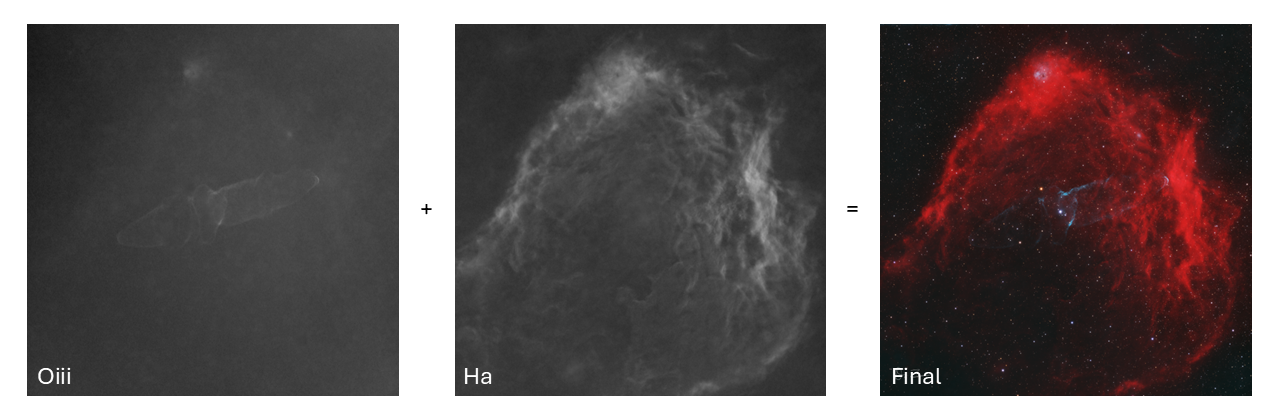
As you can see, the squid is there in the data, but it’s extremely faint, so processing it to bring it out just above the Ha signal was a bit of a nightmare. That said, I’m reasonably happy that i was able to capture such a difficult, faint target from my location, and like i said before - the answer is almost always more integration. I’m doubtful I would have turned up much signal with this amount of integration time with anything slower than f/4, but either way, it’s there! I wanted to use a somewhat light touch in processing as well. I could only push the data so far.
For processing, I experimented a little bit more with my approach, this time to try to tease more out of the Oiii data. RGB stars, were overlaid on the combined Ha and Oiii data, which were blended utilizing the NBColourMapper script this time. As usual, I started with Blink and Subframe Selector in Pixinsight to remove any outlier frames. I stacked in Siril with the OSC_Preprocessing_BayerDrizzle for the OSC image, and my modified Mono_Preprocessing_w/Drizzle script to drizzle the mono frames.
After stacking, the master lights come back to Pixinsight for Spectrophotometric Flux Calibration and Multiscale Gradient Correction. Then some Background Neutralization and Spectrophotometric Color Calibration for the RGB image. This time I used “Correct Only” on BlurX and then ran StarNet to create the star mask. I then stretched the stars with SetiAstro’s Star Stretch. Something new this time, I ran the FWHMEccentricity process to measure the PSF for the Ha and Oiii images, which I would then use as the PSF value for BluX nebulosity sharpening. Next, like the RGB image, I ran BlurX with Correct Only (probably unnecessary since I wasn’t using the the narrowband stars) and then Starnet to create starless Oiii and Ha images. As I mentioned, I then ran BlurX on the Oiii and Ha data to sharpen it with the measured PSF values. I feel like it gave me a little more control over the BlurX result. My previous process was a bit lazy with a preset BlurX value I liked one time, which I eventually noticed was producing some “hallucinated worm” details that I wanted to eliminate.
I then ran a Multiscale Adaptive Stretch and Statistical Stretch on both images to see which result I liked best. I used the Multiscale Stretch on the Oiii Statistical Stretch on the Ha. I also ran NoiseX on the starless images, and made some adjustments to the NoiseX settings I typically used. I then used Generalized Hyperbolic Stretch to try to tease more signal out of the Oiii data, which helped a little bit. I made some minor curves adjustments to both and increased the overall signal slightly. I then used the NBColourMapper script to blend the images and compared them against the HOO and “Realistic2” palettes from Franklin Marek’s Perfect Palette Picker script and found I preferred the NBColourMapper version the best. After some final slight curves adjustments to RGB/K and saturation of the nebulosity, I added the star mask back to the image with pixel math. Enjoy!
Technical Details
Imaging Telescope: William Optics RedCat 51 II, Celestron C6 XLT SCT
Imaging Camera: ZWO ASI533MC Pro, ZWO ASI533MM Pro
Mount: Sky-Watcher EQ6-R Pro, DIY 3d Printed Harmonic Mount
Filter: Astronomik L-3 Luminance UV/IR Block 2", Astronomik MaxFR 12nm Ha 1.25”, Astronomik MaxFR 12nm Oiii 1.25”, Astronomik MaxFR 12nm Sii 1.25”
Accessories: ZWO ASIAIR Plus, ZWO EAF, Antlia OAG and Filter Drawer Assembly, Starizona Filter Drawer 2", Starizona HyperStar 6 v4
Software: StarNet, PixInsight, BlurXTerminator, NoiseXTerminator, SetiAstro Statistical Stretch, SetiAstro Star Stretch, Siril, ZWO ASIAIR
Guiding Telescope: William Optics UniGuide 32
Guiding Camera: ZWO ASI174MM, ZWO ASI220MM
Imaging Dates: October 1, 3, and 4, 2026
Integration Time: 31h30m
(gain 0, f/4.9, -10c, L3): 230×180” (11h30m)
(gain 101, f/1.9, -10c, Ha): 110×180” (5.5h)
(gain 101, f/1.9, -10c, Oiii): 210x180” (10h30m)
Darks/Flats/Dark Flats: 30/30/30
Bortle Dark-Sky Scale: 6.00