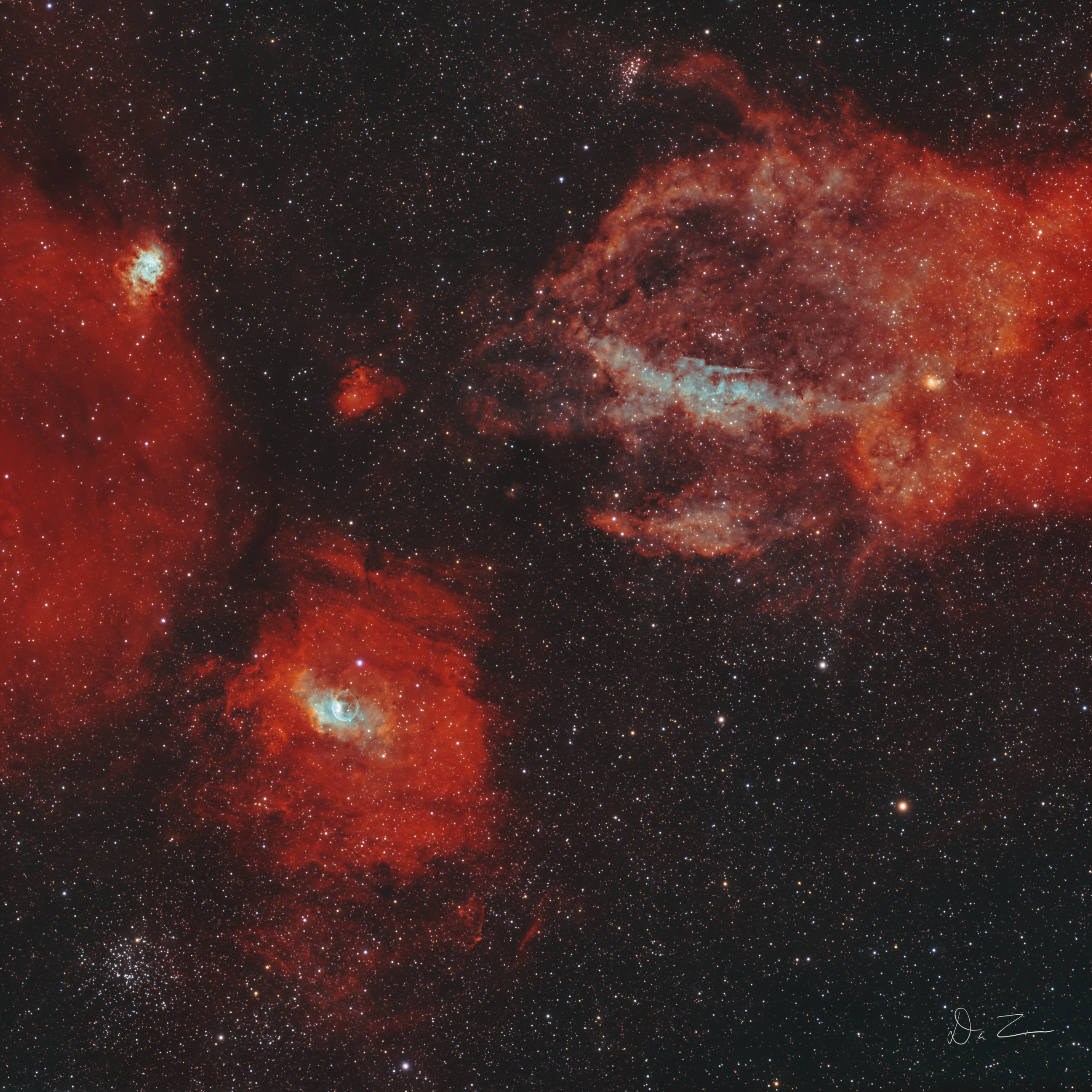
The Bubble, Lobster Claw, and Northern Lagoon
The Bubble Nebula (NGC 7635), and its neighbors the Lobster Claw Nebula (Sh2-157), and the Northern Lagoon Nebula (NGC 7538) are all cosmic neighbors in the constellation Cassiopeia. All three objects lie between approximately 7,000-11,000 light years from us. The Bubble Nebula’s central star is 45 times more massive than our sun, and its stellar wind moves at over 4 million miles per hour. This wind ionizes the cold, interstellar gas in front of it, causing it to glow and show us its distinctive bubble shape. The Lobster Claw is much more diffuse, with the stellar winds of many massive stars causing its ionization. The Northern Lagoon Nebula is a stellar nursery, and it reportedly contains one of the largest known protostars in our galaxy, which is 300 times larger than our own solar system. Finally, in the lower left corner of the image, at approximately 4,600 light-years away, is the Scorpion Cluster (M52), though its light is mildly obscured by interstellar dust, which is an effect known as “extinction.”
October 12, 2026
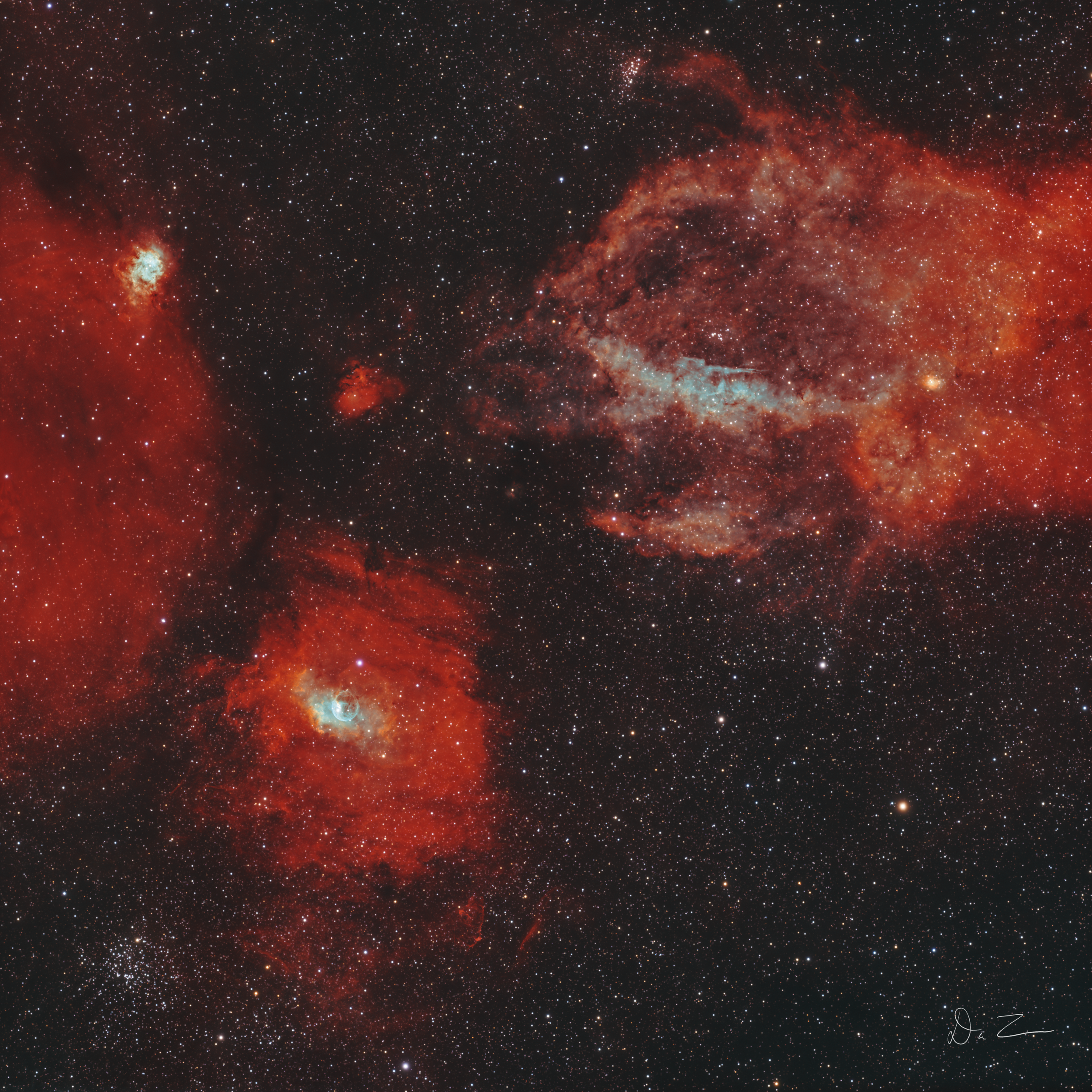
Open the image in a new tab for full resolution.
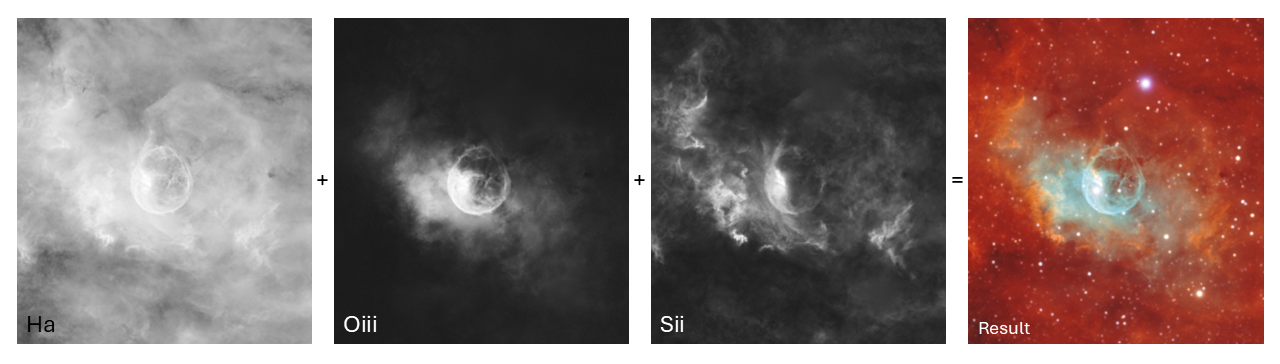
This group of objects is a new target for me. This is also the first time I’ve imaged in all three of the “typical” narrowband wavelengths (Ha, Oiii, and Sii). It was really interesting to see how the result compared between all three bands. As you can see in the comparison images below, as is typical, Ha is the dominant signal, but other small details reveal themselves in the Oiii and especially the Sii wavelengths. The Sii shows interesting, stark cliffs of ionized gas near the Bubble Nebula, that appear as orange/gold in the main image:
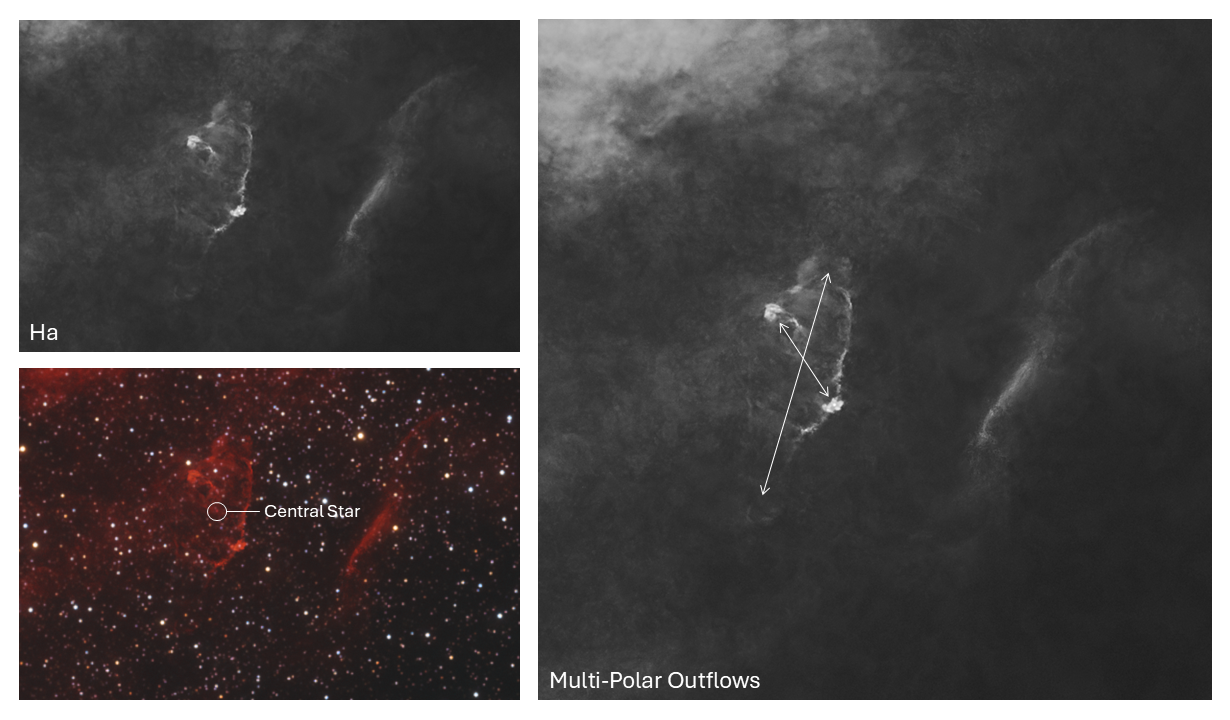
Another interesting nugget is close to the Bubble, but opposite of M52. Turns out it is a somewhat rare, multi-polar planetary nebula known as KjPn8 or PK-112.01. It is unique because of it’s bipolar shape, having also earned the recent nickname of the “Croissant Nebula.” The shape is thought to be caused by intermittent ejections from the planetary nebula at the core, with an earlier ejection of material flowing one direction (the long part of the Croissant, about 20 light-years in diameter), and a newer ejection flowing in a different direction (the shorter part of the croissant, only about 1/3-1/2 of the diameter of the longer part.) One theory suggests that the core nebula is actually formed by two stars that were originally a binary pair, that created two, distinct planetary nebula type events within 10,000-20,000 years of each other. It was originally discovered in the early seventies and is believed to be the first of its kind discovered in our galaxy:
Data gathering for this one followed the new process that I’ve undertaken with my dual scope setup. If you recall from my most recent M31 image, I encountered and issue where the DIY Harmonic Mount stopped tracking on one axis, which somewhat limited the amount of RGB I was able to collect… turns out, it was a simple fix. One grub screw on the gear attached to the DEC axis had become a little loose… so while the motor spun up and the gears turned, the rod that should turn the harmonic drive just didn’t turn with it! I fixed that and was able to use the mount again for two of the three nights of imaging for this one. I had to toss quite a few frames of Oiii and Sii, and RGB over two of the nights, due to some clouds having rolled in. Otherwise, things worked swimmingly. I stuck with 180” subframes at gain 0 for the OSC RGB images since that worked better after experimenting on M31.
For processing, I utilized a slightly modified approach to what I did with M31. The RGB image showed a slight amount of nebulosity, but not much else, so I decided to utilize only the RGB stars, and overlay those on the Ha, Oiii, and Sii images, which were blended. As usual, my process started with Blink and Subframe Selector in Pixinsight to remove any outlier frames. I stacked in Siril as usual, but this time, I used the OSC_Preprocessing_BayerDrizzle for the OSC image, and I modified the Mono_Preprocessing script to drizzle the mono frames as well. While drizzle is known to increase noise somewhat, I’ve found that with sufficient integration time and dithering every 3-5 subframes, it is a negligible increase in noise. Plus, with the current denoising tools like NoiseX, MLDenoise, GraXpert, etc., they can all handle whatever amount of noise you can throw at them. There wasn’t much noise for me on the Ha and Sii results, but the Oiii was noticeably more noisy. (Oiii always needs much more signal… even at f/1.9!) If anyone has interest in these Mono Drizzle scripts for Siril, just let me know and I’ll find a way to post them.
After stacking, I brough the master lights back to Pixinsight for Spectrophotometric Flux Calibration and Multiscale Gradient Correction (which doesn’t do much on the Mono images, but is absolutely necessary for the RGB image.) Next comes Background Neutralization and Spectrophotometric Color Calibration for the RGB image (which produced no Magenta cast on the result his time.) After color correction comes BlurX and Starnet on all images. I get rid of the star masks for the mono images but kept the RGB star mask, and ultimately decided to get rid of the RGB starless image, since (unsurprisingly) the narrowband images produced better signal on the nebulosity. Since I was going to use the mono images to generate the RGB palette, there was no need for continuum subtraction in this case. I then ran Statistical Stretch and NoiseX on all starless images. I ran HDRMST on the starless images as well. I made some minor curves adjustments to the Sii and Oiii data to try to match the target background level of the Ha, and increased the overall signal slightly. I ran a little bit of Unsharp Mask and Local Histogram Equalization on each mono image to recover some detail in the nebulosity and add a little contrast. I ran Star Stretch on the the star mask. I then used Franklin Marek’s Perfect Palette Picker to play around with some different color palettes. I found the Realistic2 and Foraxx Paleettes to be the most compelling, however I decided to blend the two 50/50 to create the final image. Realistic2 utilizes the following Pixel Math expressions for the R, G, and B channels respectively 0.7*Ha + 0.3*SII, 0.3*SII + 0.7*OIII, and OIII. So 70% Ha and 30% Sii for the Red channel, 30% Sii and 70% Oiii for the Green Channel, and 100% Oiii for the Blue channel. Foraxx is a little more complicated: (OIII^~OIII)SII + ~(OIII^~OIII)Ha, ((Ha*OIII)^~(Ha*OIII))Ha + ~((Ha*OIII)^~(Ha*OIII))*OIII, and OIII. The Foraxx result showed better contrast in color, but the color Palette of Realistic2 was easier on the eyes, so I blended them. After some final slight curves boosts to saturation and chrominance in the nebulosity, I added the star mask back to the image with pixel math, and this is the result. Enjoy!
Technical Details
Imaging Telescope: William Optics RedCat 51 II, Celestron C6 XLT SCT
Imaging Camera: ZWO ASI533MC Pro, ZWO ASI533MM Pro
Mount: Sky-Watcher EQ6-R Pro, DIY 3d Printed Harmonic Mount
Filter: Astronomik L-3 Luminance UV/IR Block 2", Astronomik MaxFR 12nm Ha 1.25”, Astronomik MaxFR 12nm Oiii 1.25”, Astronomik MaxFR 12nm Sii 1.25”
Accessories: ZWO ASIAIR Plus, ZWO EAF, Antlia OAG and Filter Drawer Assembly, Starizona Filter Drawer 2", Starizona HyperStar 6 v4
Software: StarNet, PixInsight, BlurXTerminator, NoiseXTerminator, SetiAstro Statistical Stretch, SetiAstro Star Stretch, Siril, ZWO ASIAIR
Guiding Telescope: William Optics UniGuide 32
Guiding Camera: ZWO ASI174MM, ZWO ASI220MM
Imaging Dates: October 1, 3, and 4, 2026
Integration Time: 31h30m
(gain 0, f/4.9, -10c, L3): 250×180” (12h30m)
(gain 101, f/1.9, -10c, Ha): 140×180” (7h)
(gain 101, f/1.9, -10c, Oiii): 130x180” (6h30m)
(gain 101, f/1.9, -10c, Sii): 110x180” (5h30m)
Darks/Flats/Dark Flats: 30/30/30
Bortle Dark-Sky Scale: 6.00