The Heart Nebula
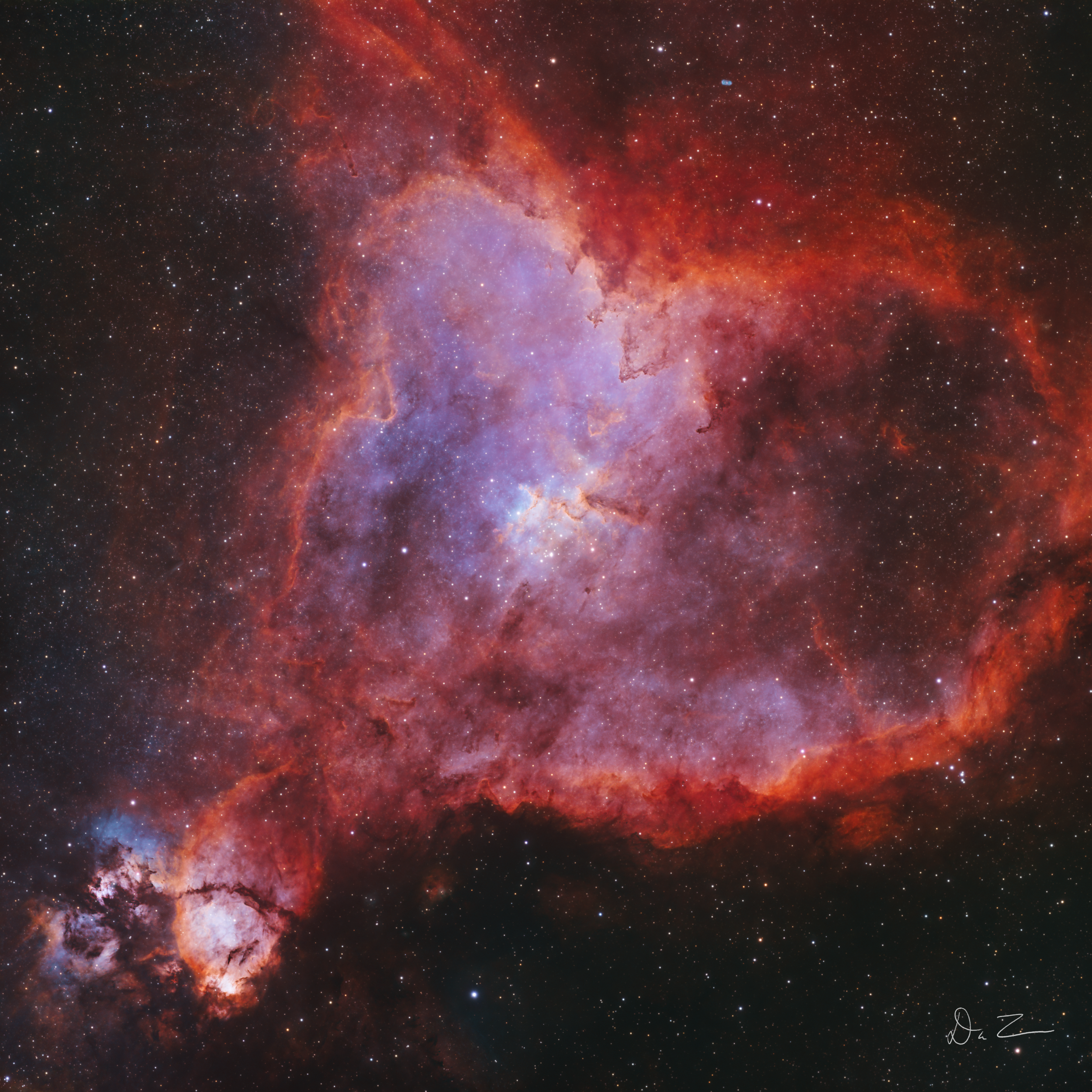
About 7500 light-years away, IC 1805 is known as the Heart Nebula. It is a classic nebula of ionized hydrogen gas in Cassiopeia that is glowing from the intense radiation of some hot stars in the core (which gives it it’s orange/red color.) The small ball in the corner is NGC 896, which is a similar, smaller emission nebula.
October 28, 2026
Open the image in a new tab for full resolution.
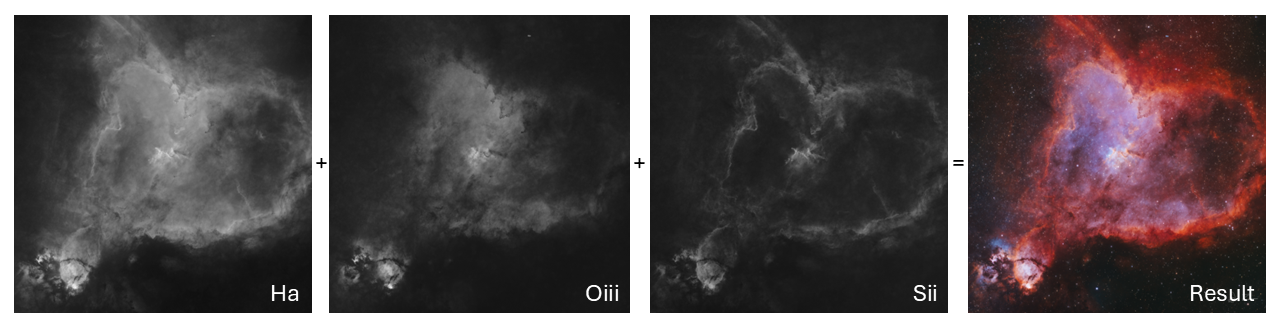
Once again, we’re revisiting some old targets, but in mono! For this one, I grabbed some time on all three narrowband wavelengths (Ha, Oiii, and Sii). As usual, it’s really interesting to see how the result compares between all three bands. Even with half the integration time at only 2.5h, the Ha signal was cleaner than the Oiii and Siii signal. As usual, red Ha dominates the overall signal, and the Sii data adds interesting gold ionization cliffs:
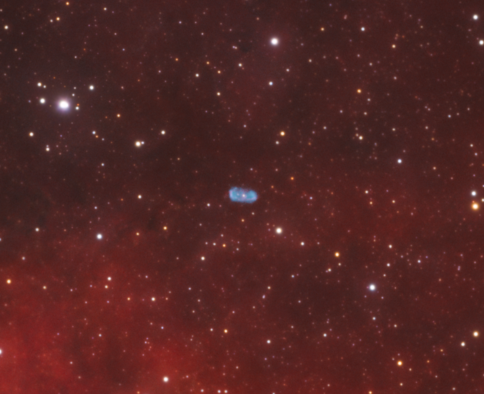
Primarily In the Oiii data (and faintly in the Ha data), we find a teeny tiny little planetary nebula called WeBo1 (also known as PN G135.6+01.0). Only recently discovered in 1996, the planetary nebula surrounds a relatively cool “Barium star” (V1169 Cassiopeiae) located about 5,000 light-years from Earth. Other, higher resolution images of WeBo1 show that it has a binary companion that is a white dwarf. This binary system has a 5 day rotation period. This rotation led to the HII gas being preferentially ejected in an orbital plane, resulting in the ring shape of the planetary nebula:
Data gathering for this one followed the new process that I’ve undertaken with my dual scope setup. I imaged this target during a 3-4 spare hours on the nights I was imaging the Flying Bat and Squid, after that had fallen too low on the horizon to image. I tossed some frames due to clouds and running into sunrise on each night. Overall, things went well and thew dual scope/mount setup seems to be working nicely, and I think I’m getting better star color shooting at gain 0 on the 533MC Pro.
For processing, I stuck with the OSC RGB stars-only (although the image showed surprisingly decent nebulosity!), and overlaid those with a blend of the Ha, Oiii, and Sii data. As usual, my process started with Blink and Subframe Selector in Pixinsight to remove any outlier frames. I stacked in Siril using the OSC_Preprocessing_BayerDrizzle for the OSC image, and my modified the Mono_Preprocessing_wDrizzle script to drizzle the mono frames as well.
After stacking, I brough the master lights back to Pixinsight for Spectrophotometric Flux Calibration and Multiscale Gradient Correction on all images, except the Sii, which I used SetiAstro’s Automatic DBE. MSGC does not have Sii data in the database to build the gradient model. I also ran the FWHMEccentricity process to determine the PSF for each image. Next was Background Neutralization and Spectrophotometric Color Calibration for the RGB image, and BlurX with “correct-only” and Starnet on all images. I got rid of the star masks for the mono images but kept the RGB star mask. I then ran Statistical Stretch and NoiseX on all starless images. I have found that I’m starting to prefer the result when dialing in the settings with “Intensity/Frequency Separation” checked on NoiseX. I ran HDRMST on the starless images and made some minor curves adjustments to the Sii and Oiii data to try to match the target background level of the Ha, as well as increasing the overall signal of all three slightly. I ran Star Stretch on the the star mask. I again used Franklin Marek’s Perfect Palette Picker to play around with some different color palettes and landed on Realistic2, and finally, made some curves adjustments to the combined starless image to enhance saturation or luminosity. I added the star mask back to the image with pixel math, and this is the result.
As a Halloween season bonus, I also generated the image in an HSS palette, since it produces such a dramatic palette. Enjoy:
Technical Details
Imaging Telescope: William Optics RedCat 51 II, Celestron C6 XLT SCT
Imaging Camera: ZWO ASI533MC Pro, ZWO ASI533MM Pro
Mount: Sky-Watcher EQ6-R Pro, DIY 3d Printed Harmonic Mount
Filter: Astronomik L-3 Luminance UV/IR Block 2", Astronomik MaxFR 12nm Ha 1.25”, Astronomik MaxFR 12nm Oiii 1.25”, Astronomik MaxFR 12nm Sii 1.25”
Accessories: ZWO ASIAIR Plus, ZWO EAF, Antlia OAG and Filter Drawer Assembly, Starizona Filter Drawer 2", Starizona HyperStar 6 v4
Software: StarNet, PixInsight, BlurXTerminator, NoiseXTerminator, SetiAstro Statistical Stretch, SetiAstro Star Stretch, Siril, ZWO ASIAIR
Guiding Telescope: William Optics UniGuide 32
Guiding Camera: ZWO ASI174MM, ZWO ASI220MM
Imaging Dates: October 17, 18, 21, and 27, 2026
Integration Time: 31h30m
(gain 0, f/4.9, -10c, L3): 100×180” (5h)
(gain 101, f/1.9, -10c, Ha): 50×180” (2.5h)
(gain 101, f/1.9, -10c, Oiii): 100x180” (5h)
(gain 101, f/1.9, -10c, Sii): 100x180” (5h)
Darks/Flats/Dark Flats: 30/30/30
Bortle Dark-Sky Scale: 6.00
November 1, 2024

Completely reprocessed in PixInsight.
Technical Details
Imaging Telescope: William Optics RedCat 51 II
Imaging Camera: ZWO ASI533MC Pro
Mount: Sky-Watcher EQ6-R Pro
Filter: Antlia Tri-band RGB Ultra Filter - 2” Mounted
Accessories: ZWO ASIAIR Plus, ZWO EAF, ZWO Filter Drawer (Gen 2)
Software: PixInsight, Starnet, BlurXterminator, NoiseXterminator
Guiding Telescope: William Optics UniGuide 32
Guiding Camera: ZWO ASI174MM
Imaging Dates: Jan. 2, 2024
Frames (gain 101.0) f/4.9 -10c: 30x180” (1h30m)
Integration Time: 1h30m
Darks/Flats/Dark Flats: 30/30/30
Bortle Dark-Sky Scale: 6.00
January 3, 2024

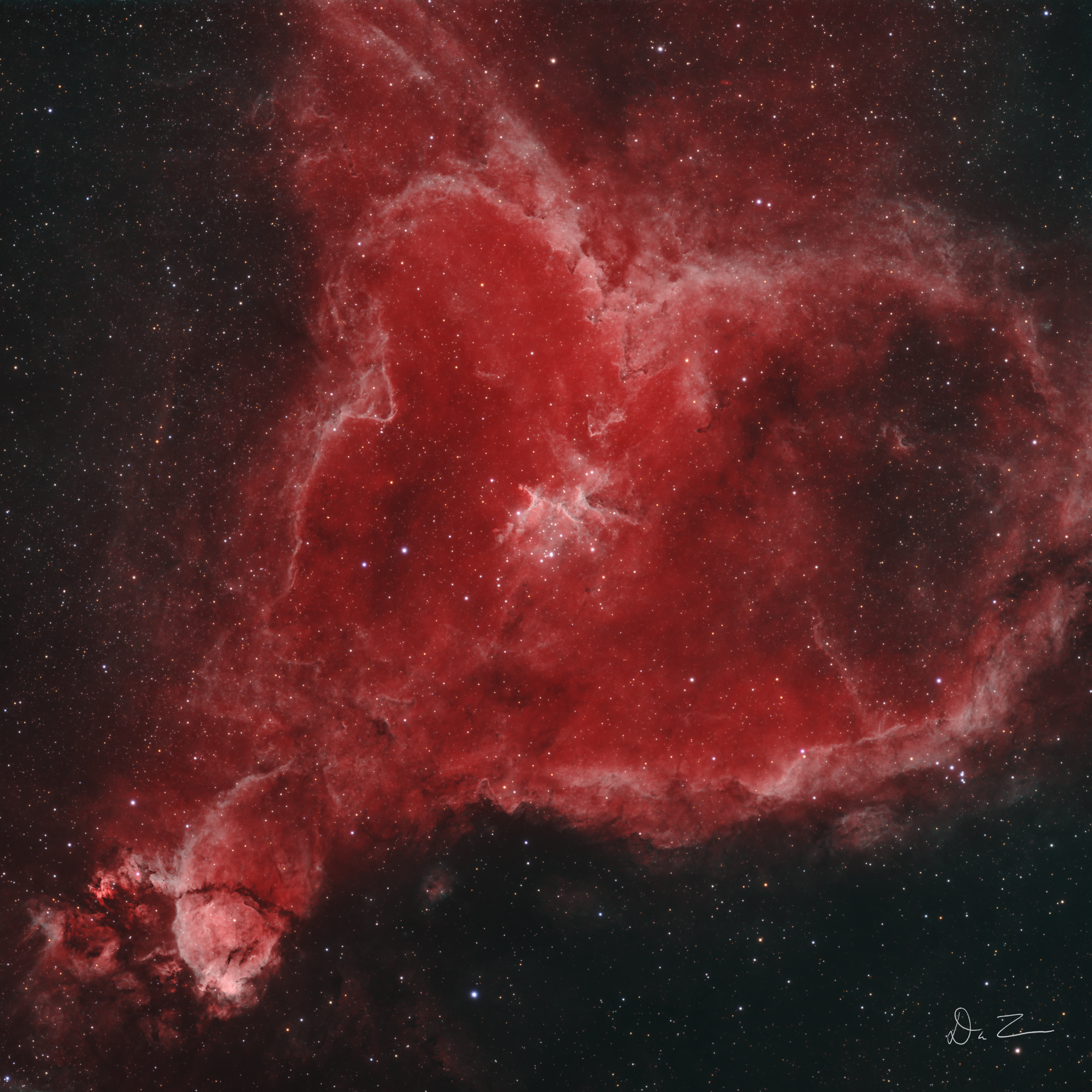
My first image of the Heart Nebula. Only an hour and a half of data on this one so far, but I was eager to give it a go! I found this target very difficult to image from my location, as it's toward the northern sky, which is toward my greatest source of light pollution. I tried before with a UV/IR cut filter and it just didn't give me satisfactory results. This is the my second attempt on the target, but this time with an Antlia Tri-band filter, and boy what a difference it makes! The nebulosity pops out pretty well (thought maybe not as well as with a more narrow dual band filter), but I'm very pleased with the image overall: the star color is good, and the gains on the nebulosity were significant over my UV/IR cut filter.
Technical Details
Imaging Telescope: William Optics RedCat 51 II
Imaging Camera: ZWO ASI533MC Pro
Mount: Sky-Watcher EQ6-R Pro
Filter: Antlia Tri-band RGB Ultra Filter - 2” Mounted
Accessories: ZWO ASIAIR Plus, ZWO EAF, ZWO Filter Drawer (Gen 2)
Software: Siril, Starnet, Photoshop, NoiseXterminator
Guiding Telescope: William Optics UniGuide 32
Guiding Camera: ZWO ASI174MM
Imaging Dates: Jan. 2, 2024
Frames (gain 101.0) f/4.9 -10c: 30x180” (1h30m)
Integration Time: 1h30m
Darks/Flats/Dark Flats: 30/30/30
Bortle Dark-Sky Scale: 6.00