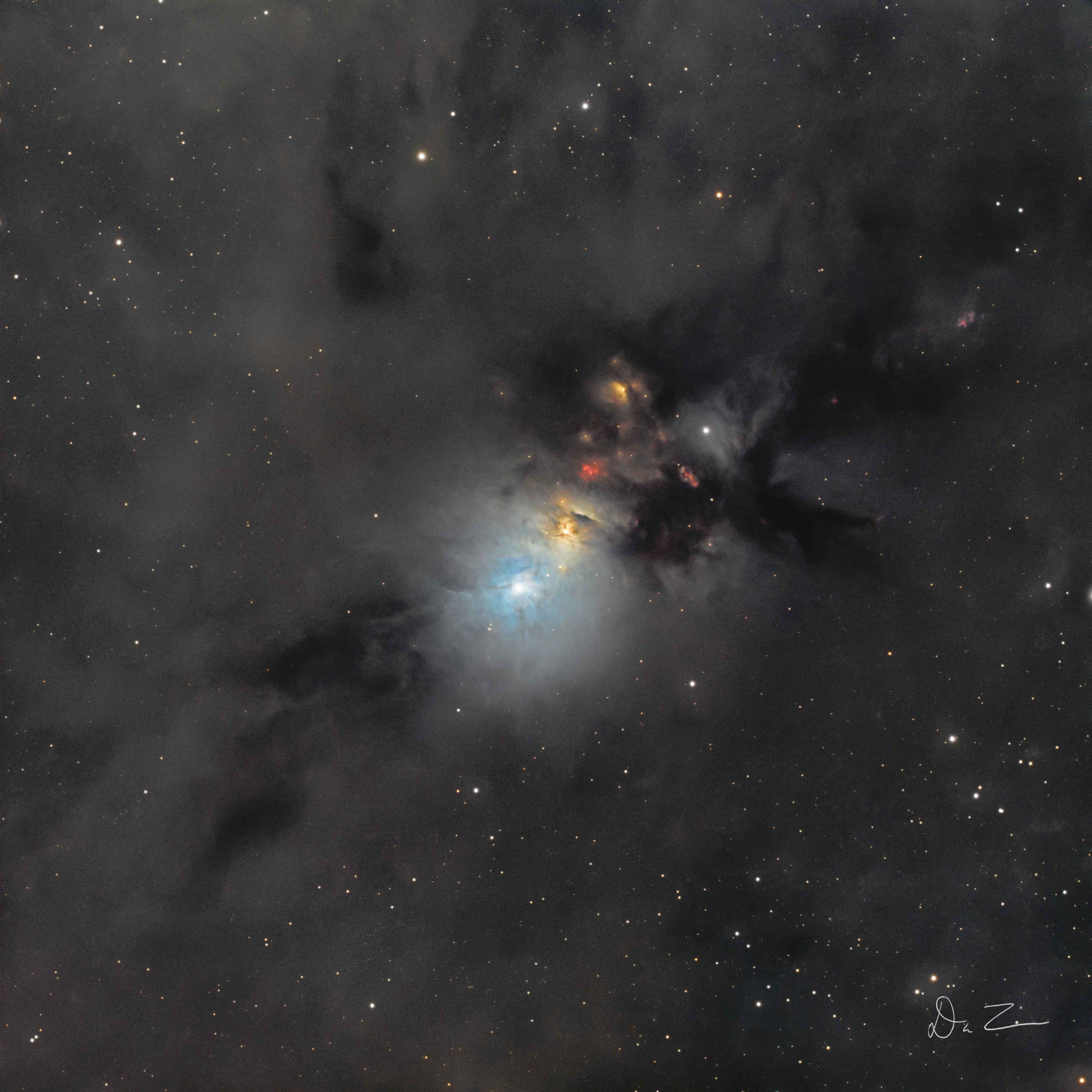
The Embryo Nebula
NGC1333, The Embryo Nebula, is in the Perseus molecular cloud, and is located approximately 960 light-years away. The nebula has a fascinating mix of glowing gasses and pitch-black dust, which has been stirred up and blown around by several hundred newly forming stars embedded within the dark cloud of dust. The stellar winds from the bright blue star in the center are blowing through a curtain of dust. Next to it, another super-hot star shines through filaments of obscuring dust, filtering the starlight, resulting in a yellowish glow. Ultimately, the region earns its name due to it being a rich stellar nursery. There are many glowing red pockets of ionized hydrogen, indicative of newly formed where stars and protostars are accreting material, carving their place in the universe within the cloud of dust. These stars are surrounded by circumstellar disks, which may eventually produce planetary systems.
February 15, 2025
The Embryo Nebula is a beautiful, dynamic, and interesting object in the night sky. I’ve wanted to capture it for some time, but I was hesitant because part of what makes it so interesting are the dense clouds of dust surrounding it, and I wasn’t confident that I would be able to bring out any of this material without dozens of hours of imaging time from my suburban imaging location and my slightly slower optics at f/5.6. I figured I should try anyway, and this was the result. Ultimately I’m fairly happy with it, but I ran into several hiccups along the way.
You’ll notice that I have several nights of imaging, a few of which had few subframes. I had originally intended to capture about 6-7 hours of subframes over 2 nights, expecting a total of about 12 hours of integration time before I would even bother stacking the image to see what I got. It ended up taking 5 nights to reach that amount.
My usual process in deciding whether or not to image is to check my weather app to see if it will be clear or mostly clear for the majority of the night according to the hour-by-hour forecast, with winds under 10mph, and gusts under 15 mph or so. Then I check Meteoblue to get an idea of relative cloud cover, and how the seeing compares to typical conditions. If any of the low-mid-high cloud cover is >10 for more than an hour or two, I usually won’t bother imaging, as this is usually indicative of those thinner, barely perceptible clouds that wash-out 180” exposures, making them pretty useless. I also don’t think Meteoblue’s seeing calculation is precise, however, I do think it’s helpful in determining if seeing conditions are better or worse than average. Seeing is usually somewhere in the 0.55”-0.65” range for my location according to Meteoblue, sometimes ticking up into the 0.75”-0.9” range, and sometimes all the way down to about the 0.3”-0.4” range. Under my imaging conditions with wind and other factors, I think my seeing limitation is well above even the highest of range, but it’s still helpful information to know. When the seeing is better than average, I can typically guide within the range of 0.35”-0.5” total RMS with my OAG on the AT115EDT, and focused star sizes somewhere around 2.6-3.1 with the L3 filter according to the EAF routine on ASIAir. On worse than average nights, guiding is typically in the range of 0.65”-0.8” total RMS, with star sizes somewhere between 3.4-4.0. Star sizes are usually a bit lower when I’m using the ALP-T filter due to it's tighter bandpass. According to astronomy.tools FOV calculator, my AT115EDT with the 0.8x reducer and the 3.76 micron pixels on my 533mc Pro camera, my pixel scale is about 1.20” per pixel, compared to the Dawes limit for the telescope which is about 1.01”.
This is all entirely too much detail to say that I ultimately lost about half of my subframes to more clouds than forecast, poor star selection by the ASIAir for guiding, resulting in worse than usual guiding, (perhaps due to the dust in the starfield, or perhaps just bad luck), and my favorite silly that error I encountered that took two nights to understand and solve, the ASIAir shutting down during the meridian flip one night because the power cable rotated in the socket on the ASIAir just enough to cause it to shut down mid-flip. I decided to stay up to observe the flip the next night and watch it happen, and was able to restart the sequence to salvage the imaging run. I had originally thought that a loose USB cable connection might have caused the issue, so I ordered a new cable for that, but even after replacing the cable with one that uses the hand controller port on the EQ6r-Pro, it still happened. After some fiddling about, testing connections, I discovered the power cable rotating in the socket as the culprit. Interestingly enough, this problem has not been repeated on other targets, so I’m guessing the nature of motion of the meridian flip for this specific target must’ve caused it. It’s always something!
Technical Details
Imaging Telescope: Astro-Tech AT115EDT
Imaging Camera: ZWO ASI533MC Pro
Mount: Sky-Watcher EQ6-R Pro
Filter: Astronomik L-3 Luminance UV/IR Block 2"
Accessories: Antlia OAG and Filter Drawer Assembly, Astro-Tech AT115EDT .8X Reducer, ZWO ASIAIR Plus, ZWO EAF
Software: StarNet, PixInsight, BlurXTerminator, NoiseXTerminator, SetiAstro Star Stretch, SetiAstro Statistical Stretch, Siril, ZWO ASIAIR
Guiding Camera: ZWO ASI174MM
Imaging Dates: January 10, 14, 17, 19, and February 14, 2026
Frames (gain 101.0) f/4.9 -10c: 250x180” (12h30m)
Integration Time: 12h30m
Darks/Flats/Dark Flats: 30/30/30
Bortle Dark-Sky Scale: 6.00