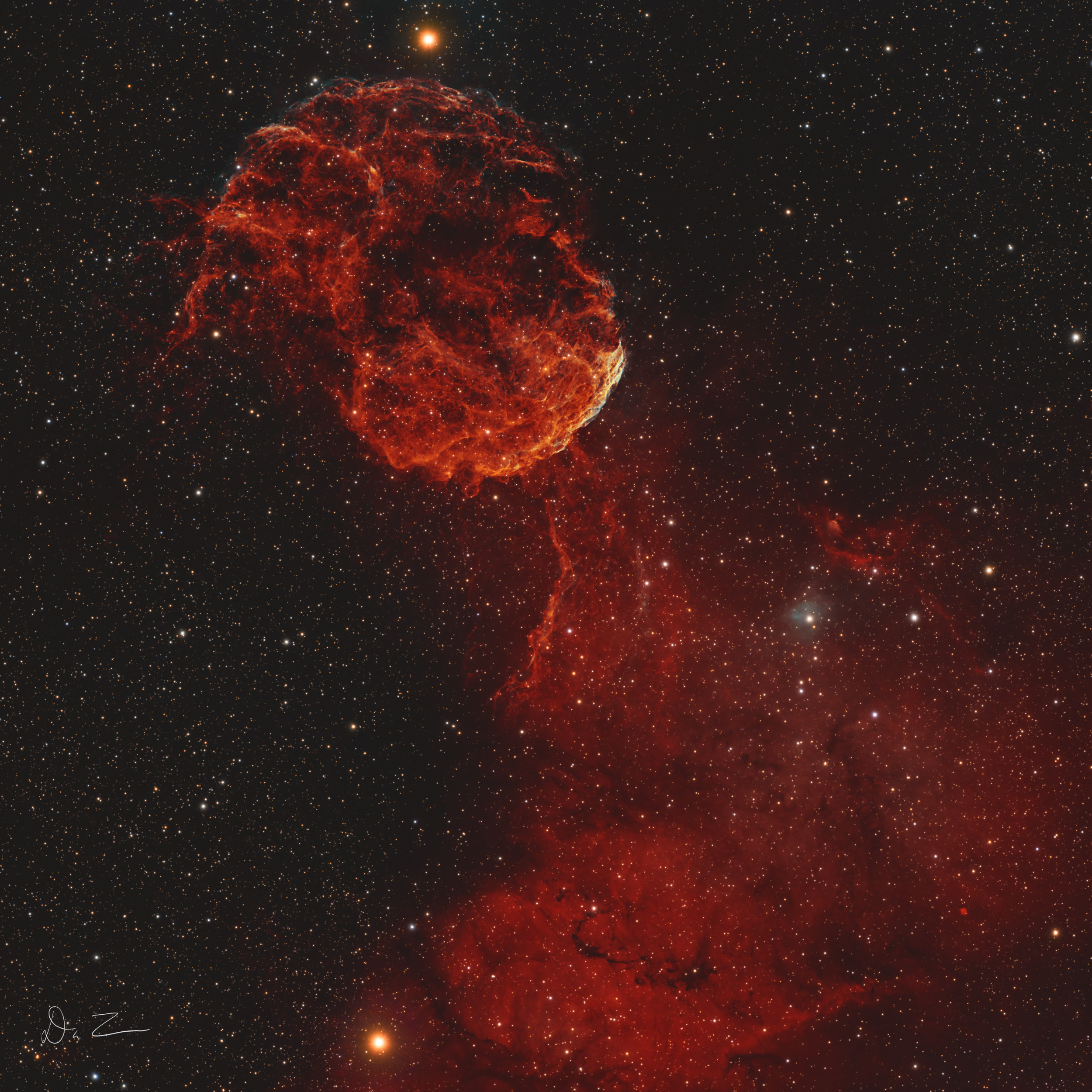
The Jellyfish Nebula
The Jellyfish Nebula (catalogued as IC443 and Sharpless 248 (Sh 2-248)) is a galactic supernova remnant (SNR) in the constellation Gemini. It is located roughly 5,000 light-years from earth. The supernova event is thought to have occurred 30,000-35,000 years ago. The remaining neutron star (CXOU J061705.3+222127) is estimated to be travelling 830,000 km/h away from the supernova site.
November 11, 2026
Open the image in a new tab for full resolution.
My first image of this was a mosaic with the Monkey Head Nebula with an OSC and the Triband filter. While the result was admirable for just shy of 4 hours of integration time, I was due to revisit this one - but in mono!
I did have on interesting tidbit come about during imaging… Near-Earth Object 2015 BR515 paid a visit in 3 of my subframes! Normally when it’s a satellite or plane, they move quickly enough to leave a single streak across one subframe… however when I noticed that this object streaked across three subframes, I realized that it couldn’t be a plane or satellite! I then went on the hunt to try to determine what this streak was. I learned about the International Astronomical Union’s Minor Planet Center, where you could type in the celestial coordinates of where you saw the object (and on what date) and it will search a database of objects with known orbits through that patch of sky. Pretty neat! In the end, my search turned up NEO 2015 BR515: an asteroid first observed by the Mount Lemmon Observatory in 2015. Try as I might, I found it difficult to parse all of the information on the Minor Planet Center website, but fortunately, I also stumbled across a fabulous website called Asteroid Today, which presents the information in a much more digestible way. From this website, I learned that it is estimated to be 123 meters in diameter, or about the size of Big Ben. It is an “Amor” type asteroid, which approach Earth's orbit from outside but never cross it, and has a perihelion that lies between Earth's and Mars' orbits. 2015 BR515 orbits the sun once every 492 days, and is not on a hazardous trajectory with Earth. Below are a couple short videos of the subframes when it passes by (faster and slower frame rates):
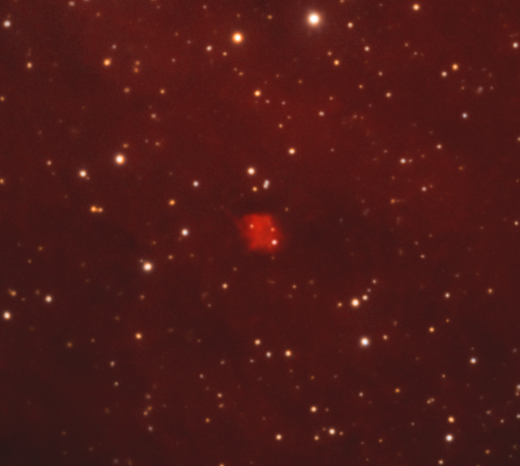
In my data, I also saw a small object that looked like a planetary nebula, and sure enough, it was! Planetary Nebula HoCr1 is nearby the Jellyfish nebula. It was discovered by amateur astronomers Michael Howell and Richard Crisp in 2006. The nebula primarily shows in Hydrogen from my data:
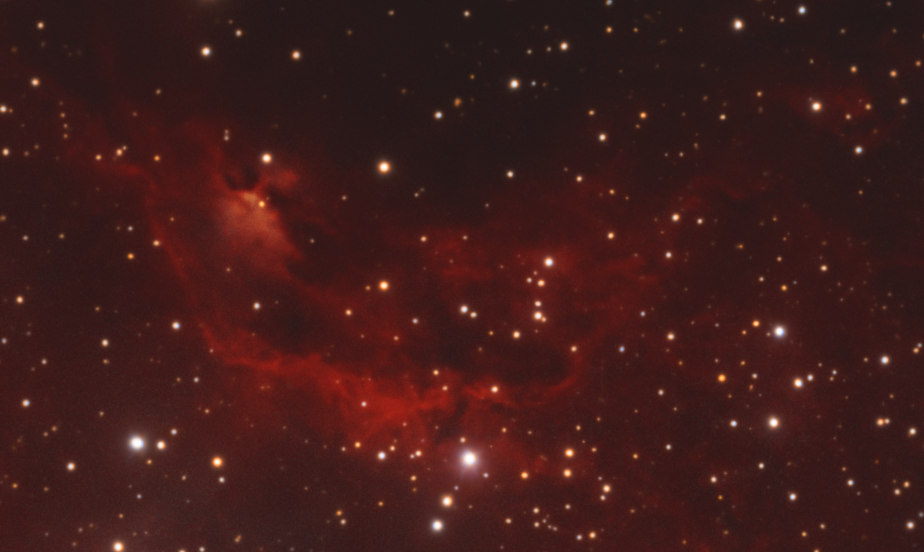
Finally, because it’s big brother IC443 gets all of the glory, I wanted to make sure that the area of compressed, ionized gas, IC444 gets a special shout out:
Diving into capture and processing: The plan was about 5 hours each of Ha, Oiii, and Sii over three nights, with RGB stars from the OSC camera. I was splitting time with the Lion Nebula, which was setting in the western sky early in the night, and I was able to switch to the Jellyfish, while remaining on the same side of the meridian. I ended up capturing about 2 hours of RGB stars on the final night, as I had the Redcat 51 trained on M45 (The Pleiades) each night, and I didn’t need many subframes just for the stars. In general, I didn’t run into any trouble with the narrowband capture, or the OSC capture (for this particular object at least… I’ll have more information on some mount struggles with my M45 image… it’s all resolved now!)
I followed my newer process for color blending. Up first, of course, it’s Blink and Image Analysis (fka Subframe Selector) in Pixinsight to remove any outlier frames. Stack in Siril using the OSC_Preprocessing_BayerDrizzle script for the OSC image, and my modified Mono_Preprocessing_wDrizzle script for the mono frames.
After stacking, it’s back into Pixinsight for Spectrophotometric Flux Calibration, Multiscale Gradient Correction on all images, except the Sii, since MSGC does not have Sii data in the database to build the gradient model. I then run the FWHMEccentricity process to determine the PSF for each image. Next was Background Neutralization and Spectrophotometric Color Calibration for the RGB image, and then BlurX with “correct-only” and Starnet on all images. Next, I got rid of the star masks for the mono images but kept the RGB star mask. I then ran Statistical Stretch and some NoiseX on all starless images. I ran HDRMST on the starless images and made some minor curves adjustments to get the Sii and Oiii data background levels to match the target background level of the Ha. I ran Star Stretch on the the star mask.
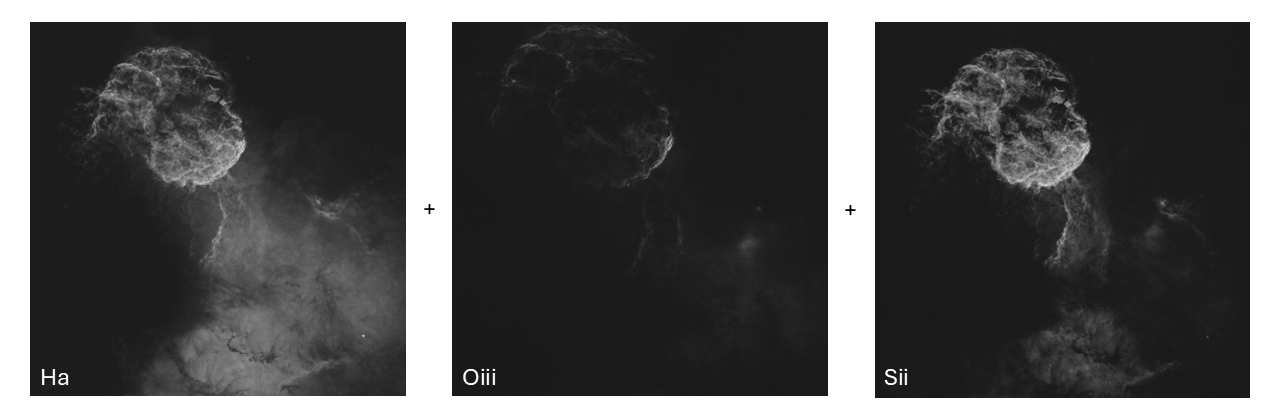
Below is the composite of the Ha, Oiii, and Sii images (you can see HoCr1 as a bright little dot in the bottom right of the Ha frame):
Just like I did before, I ran multiple palettes from Franklin Marek’s Perfect Palette Picker Pixinsight script to see how I liked them. I ultimately stuck with the Dynamic Inverse palette for its beautiful golds, and Foraxx, because it best captured the red of the Ha and the little whisps of blue from the Oiii. In turn I adjusted my palette mixer formula a little bit:
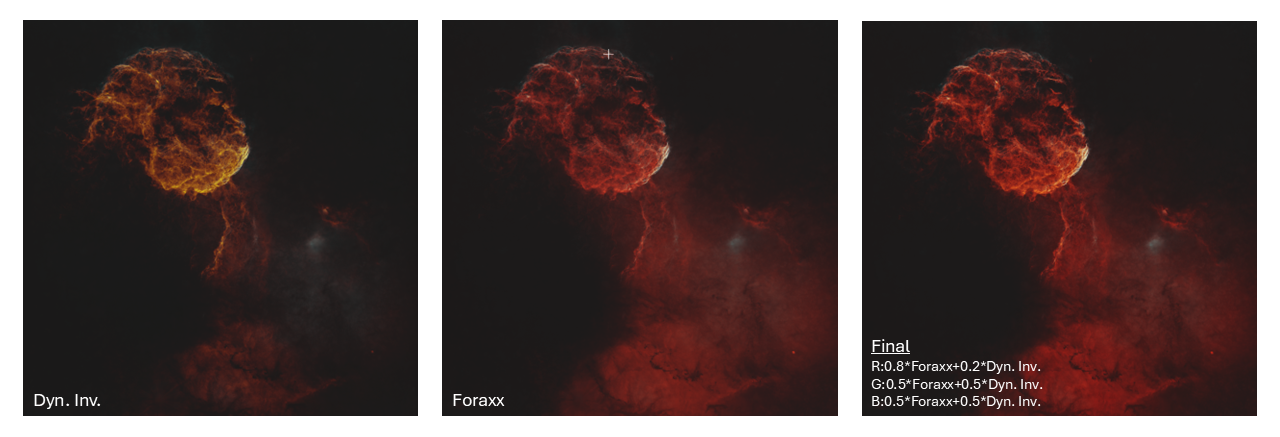
As much as I enjoy the science and learning that comes with astrophotography, I’m also enjoying the new-found artistic freedom of palette mixing that mono imaging offers. After I had my color image, I made some curves adjustments to the combined starless image to enhance saturation and luminosity. I then added the star mask back to the image with pixel math. I utilized the StarReduction script by Bill Blanshan and Mike Cranfield and ensured that I protected the smaller stars while reducing the larger stars. Enjoy!
Technical Details
Imaging Telescope: William Optics RedCat 51 II, Celestron C6 XLT SCT
Imaging Camera: ZWO ASI533MC Pro, ZWO ASI533MM Pro
Mount: Sky-Watcher EQ6-R Pro, DIY 3d Printed Harmonic Mount
Filter: Astronomik L-3 Luminance UV/IR Block 2", Astronomik MaxFR 12nm Ha 1.25”, Astronomik MaxFR 12nm Oiii 1.25”, Astronomik MaxFR 12nm Sii 1.25”
Accessories: ZWO ASIAIR Plus, ZWO EAF, Antlia OAG and Filter Drawer Assembly, Starizona Filter Drawer 2", Starizona HyperStar 6 v4
Software: StarNet, PixInsight, BlurXTerminator, NoiseXTerminator, SetiAstro Statistical Stretch, SetiAstro Star Stretch, Siril, ZWO ASIAIR
Guiding Telescope: William Optics UniGuide 32
Guiding Camera: ZWO ASI174MM, ZWO ASI220MM
Imaging Dates: November 6, and 8-10, 2026
Integration Time: 17h
(gain 0, f/4.9, -10c, L3): 40×180” (2h)
(gain 101, f/1.9, -10c, Ha): 100×180” (5h)
(gain 101, f/1.9, -10c, Oiii): 100x180” (5h)
(gain 101, f/1.9, -10c, Sii): 100x180” (5h)
Darks/Flats/Dark Flats: 30/30/30
Bortle Dark-Sky Scale: 6.00