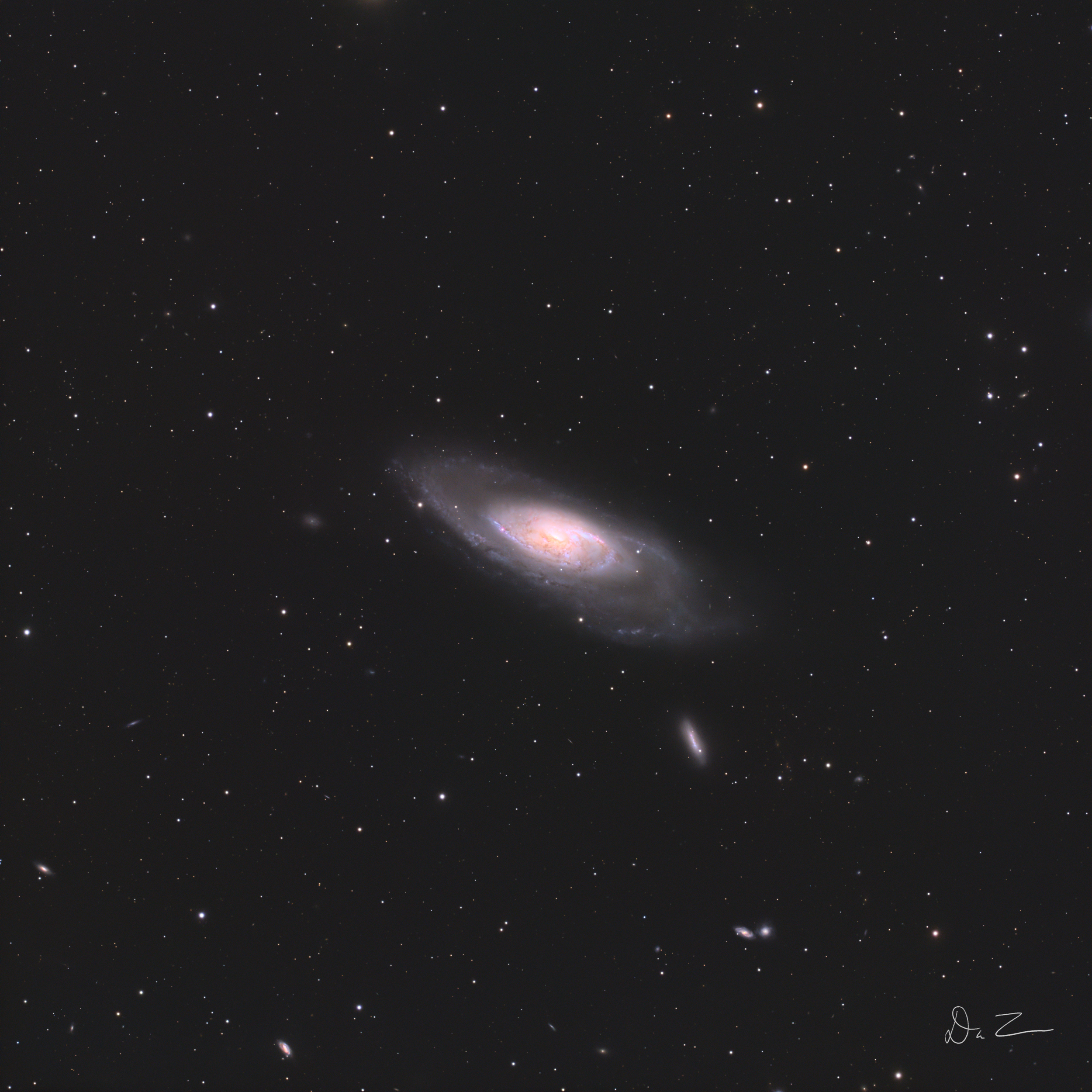
M106
About 22-25 million light-years away in the constellation Canes Venatici, you’ll find M106, a large spiral galaxy with a black hole in the center. There’s several other galaxies in this image, the most prominent of which is NGC 4217, which is about 60 million light-years away!
May 18, 2025
Through bouts of clouds and a little bit of snow(!) earlier this month, I was able to dedicate some time to our neighbor, M106. I did get rid of a few subframes for clouds, but it was otherwise a fairly straightforward imaging session. I have been working on a few astro-related projects recently - one of which is a 3D-Printed Harmonic Drive Mount with OnStep and controlled by the ASIAir+. I have been able to test it a couple of times and I saw excellent guiding (0.6”-0.7” RMS) the first night for 8 subframes and then it suddenly stopped. I had apparently set an overhead limit on OnStep that caused the mount to stop tracking when it reached the limit, even when the ASIAir+ assumed it should still be guiding. I went ahead and updated that setting (as well as a few more) and tried again the next night and I couldn’t keep total guiding RMS under 1”-1.5”. So I need to revise the other settings and try again another night. I’m hoping to have it running smoothly soon so I can consistently run two scopes each night and speed up data collection!
Technical Details
Imaging Telescope: Astro-Tech AT115EDT
Imaging Camera: ZWO ASI533MC Pro
Mount: Sky-Watcher EQ6-R Pro
Filter: Astronomik L-3 Luminance UV/IR Block 2"
Accessories: Antlia OAG and Filter Drawer Assembly, Astro-Tech AT115EDT .8X Reducer, ZWO ASIAIR Plus, ZWO EAF
Software: StarNet, PixInsight, BlurXTerminator, NoiseXTerminator, SetiAstro Star Stretch, SetiAstro Statistical Stretch, Siril, ZWO ASIAIR
Guiding Camera: ZWO ASI174MM
Imaging Dates: May 6 and 11, 2026
Frames (gain 101.0) f/4.9 -10c: 200x180” (10h)
Integration Time: 10h
Darks/Flats/Dark Flats: 30/30/30
Bortle Dark-Sky Scale: 6.00
April 12, 2024

Last night I was able to spend a good amount of time imaging the region of galaxies around M 106. One plus to having a wide-field scope is you can see the cosmic neighborhood of just about any object. Here we've got M106 at the center of the image, and a generous handful of other galaxies appearing as well. The second most prominent galaxy just to the lower left of M106 is NGC 4217. The Small Galaxy just below M106 is NGC 4248, and the one further toward the bottom of the image is NGC 4220. Toward the top of the image, just to the right of center is NGC 4346, and the faint galaxy just left of center is NGC 4288, and the faint one in the top left, I believe is UGC 7408. And that's only the most prominent ones! There's dozens of other galaxies in this image that are small and faint, and hundreds more that are simply too faint to see or otherwise got lost in processing. Some day I do plan to add a longer focal length telescope to my arsenal so I can better capture these objects in more detail.
Technical Details
Imaging Telescope: William Optics RedCat 51 II
Imaging Camera: ZWO ASI533MC Pro
Mount: Sky-Watcher EQ6-R Pro
Filter: Antlia Tri-band RGB Ultra Filter - 2” Mounted
Accessories: ZWO ASIAIR Plus, ZWO EAF, ZWO Filter Drawer (Gen 2)
Software: Siril, Starnet, Photoshop, NoiseXterminator
Guiding Telescope: William Optics UniGuide 32
Guiding Camera: ZWO ASI174MM
Imaging Dates: Apr. 11, 2024
Frames (gain 101.0) f/4.9 -10c: 80x180” (4h)
Integration Time: 4h
Darks/Flats/Dark Flats: 30/25/30
Bortle Dark-Sky Scale: 5.00